SELECT CATEGORY
Discover free nonprofit investing resources, including policies, guides, and templates, to keep your investment or endowment program running strong.
Discover free nonprofit investing resources, including policies, guides, and templates, to keep your investment or endowment program running strong.
Learn how nonprofits can structure endowment gifts, balance donor intent with long-term flexibility, and determine when general, named, or restricted funds make the most sense.
THE ENDOWMENT PLAYBOOK · PART 4 OF 4
Before you decide how to restrict a gift, decide whether it needs a restriction at all.
A donor sits down with your executive director and says the words every development officer hopes to hear: "We'd like to make a significant gift to the endowment." Then comes the second sentence: "And we'd like it to fund scholarships for first-generation students from Clark County who plan to study nursing."
Most organizations go straight to the mechanics. What should the fund be called? How should the purpose be worded? What goes in the gift agreement? But there's a prior question worth asking every time a significant gift is on the table, and it's the one most often skipped.
The first question isn't "how should we restrict this gift?" It's "does this gift need to be restricted at all?"
A quick note on terms. Any gift a donor directs to the endowment already carries one restriction: it's meant to be held and invested for the long term rather than spent. In this article, "unrestricted" and "general" refer to the purpose of the gift. A general endowment gift is held for the long term, but its annual distribution can support whatever the organization needs most. A restricted fund adds a second layer: the distribution can only be used for the purpose the donor specified.
For the organization, a general endowment gift is almost always the better outcome. Not because restricted gifts are bad, but because every restriction is a promise the organization has to keep for as long as the fund exists, which may be a very long time.
The Case for General Endowment Giving
MAXIMUM FLEXIBILITY. A general endowment distribution can follow the mission as it evolves. If the organization's greatest need in 2045 is something no one in the room can picture today, the fund can still support it.
NO ONGOING ADMINISTRATIVE OR LEGAL OVERHEAD. Each restricted fund needs its own tracking, its own spending decisions, its own reporting to the donor or family, and its own line in the audit. Ten small restricted funds can create more work than one large general fund.
NO RISK OF THE FUND OUTLIVING ITS PURPOSE. Programs end. Communities change. Needs get met. A general fund can't become obsolete, because its purpose is the mission itself.
If general gifts are better for the organization, why are they so uncommon at the major-gift level? Two reasons tend to show up.
First, a general gift can feel less personal and less memorable to the donor. A fund with a family name and a specific purpose feels like a legacy. A contribution to "the endowment" can feel like money disappearing into a pool.
Second, and less often acknowledged, development staff don't always offer the general option with the same enthusiasm. Named funds come with a story, a ceremony, and a plaque. The general fund often gets mentioned as an afterthought, if at all. Donors notice which option the organization seems most excited about.
The fix starts with how the general option is described. An unrestricted endowment gift isn't the "less generous" choice, or the one for donors who couldn't decide. It's a vote of confidence in the organization's judgment over time.
A general endowment gift says, "I trust the people who will lead this organization long after I'm gone to know what it needs most." That's one of the most generous things a donor can say.
This framing also gives the donor something concrete to be proud of. Their gift isn't tied to one program's fortunes. It strengthens the whole organization, in every year, in whatever direction the mission needs to go.
None of this means saying no to donors who want a named or restricted fund. It means treating restriction as a deliberate choice rather than the default. A few signals help sort which gifts warrant one.
A VERY LARGE GIFT. The gift is big enough that the restricted fund will generate meaningful annual support on its own, well above your organization's minimum for a named fund.
MULTI-GENERATIONAL FAMILY INVOLVEMENT. The donor's children or grandchildren expect to stay connected to the fund, and the named fund is part of how the family will stay engaged with your organization over decades.
A CLEAR, MULTI-DECADE PROGRAM FIT. The purpose is central to your mission and likely to remain so for the foreseeable future. Think "student scholarships" at a school, not "the 2026 summer coding pilot."
Before jumping to a fully restricted fund, it helps to put a few options in between on the table. Each one gives the donor more connection than a general gift, with far less rigidity than a narrow restriction.
FIELD-OF-INTEREST FUNDS. The gift supports a broad area of the mission, such as "youth programs" or "environmental education," rather than a single program. The organization decides which specific efforts within that area to fund each year.
LIGHTLY DESIGNATED GIFTS WITH BROAD PURPOSE LANGUAGE. The donor expresses a preference, but the purpose is written broadly enough to stay useful as programs change. These should still be documented in writing, typically in a short gift agreement or fund agreement the donor signs. The agreement records the purpose language, confirms the gift is held as part of the endowment, and ideally includes the variance power language discussed below. A one-page agreement now prevents a much harder conversation later about what the donor "really meant."
NAMING WITHOUT A LEGAL RESTRICTION. A name and a restriction are two different things. A donor can have a fund named in their honor (or a loved one's) while the gift itself remains unrestricted as to purpose. For many donors, the name is what they actually wanted.
KEY CONCEPT: A name is recognition. A restriction is a legal obligation. Donors often ask for the second when what they really want is the first.
Even with a good framework, narrow restrictions get accepted all the time. Development teams are measured on dollars raised, not on how well a gift is structured, and questioning the terms of a large gift can feel ungrateful or risky. The trouble is that the cost of a poorly structured restriction rarely shows up in the year the gift arrives. It shows up 10, 20, or 40 years later, for people who weren't in the room. Variance power is the single most important protection against that.
Variance power is a clause in a gift agreement that lets the board redirect a restricted fund if its original purpose becomes impossible, unnecessary, or inconsistent with the mission. It's standard in community foundation agreements and much less common everywhere else.
A restricted fund agreement should include it. Without it, changing an obsolete restriction usually means tracking down the donor for written consent or going through a legal process that can involve a court and the state attorney general. With it, the board has a pre-agreed way to redirect the fund to the purpose closest to the donor's original intent.
Consider a fund built to support a mobile clinic. When the clinic closes, the fund doesn't, and without variance power the choice is a slow legal process or money that sits idle.
When explaining it to a donor, the framing matters. Variance power isn't a loophole. It's how the organization protects the donor's intent over a time horizon no one can fully predict.
"Your gift is meant to last for generations. If your exact purpose ever becomes impossible, this lets our board redirect the fund to whatever comes closest to what you intended, rather than leaving it stuck or going to court."
If a restricted fund is the right answer, settle three terms before the agreement is signed. Ideally, your gift acceptance policy already sets the standard for each, so staff aren't negotiating from scratch.
MINIMUM FUNDING THRESHOLDS. The scale question applies to a named fund. At a 4% spending rate, a $250,000 fund would provide roughly $10,000 a year before expenses.* Set a minimum to establish a named restricted fund, and a balance the fund must reach before distributions begin.
REVIEW OR SUNSET CLAUSES. A commitment to revisit the fund's purpose on a set schedule, such as every ten years, ideally with the donor or family involved.
A FALLBACK PLAN. Put in writing what happens if the fund never reaches a workable size (for example, merging it into a related fund after five years, with the donor's name preserved) or if its purpose disappears entirely, which is where variance power does its work.
*The $250,000 fund illustration is purely hypothetical, provided for educational purposes only, and does not represent actual performance or advisory account results. It assumes a static market value, zero volatility, and a constant 4% annual payout rate. Actual endowment returns, portfolio market values, and available spending distributions fluctuate with changing market and economic conditions. Figures are presented gross of fees. The deduction of investment advisory fees, custodian charges, and underlying investment product expenses will reduce actual cash distributions and cumulative portfolio growth over time. Past performance and hypothetical projections guarantee no future results.
Without variance power, state law sets the options for an obsolete restriction. Under UPMIFA, there are generally three paths:
See our UPMIFA Compliance Checklist for a plain-language walkthrough, and consult counsel on your state's requirements.
The most effective approach is to present the options as a menu, not a hierarchy of generosity. Each structure reflects a different kind of commitment, and none is "the lesser gift."
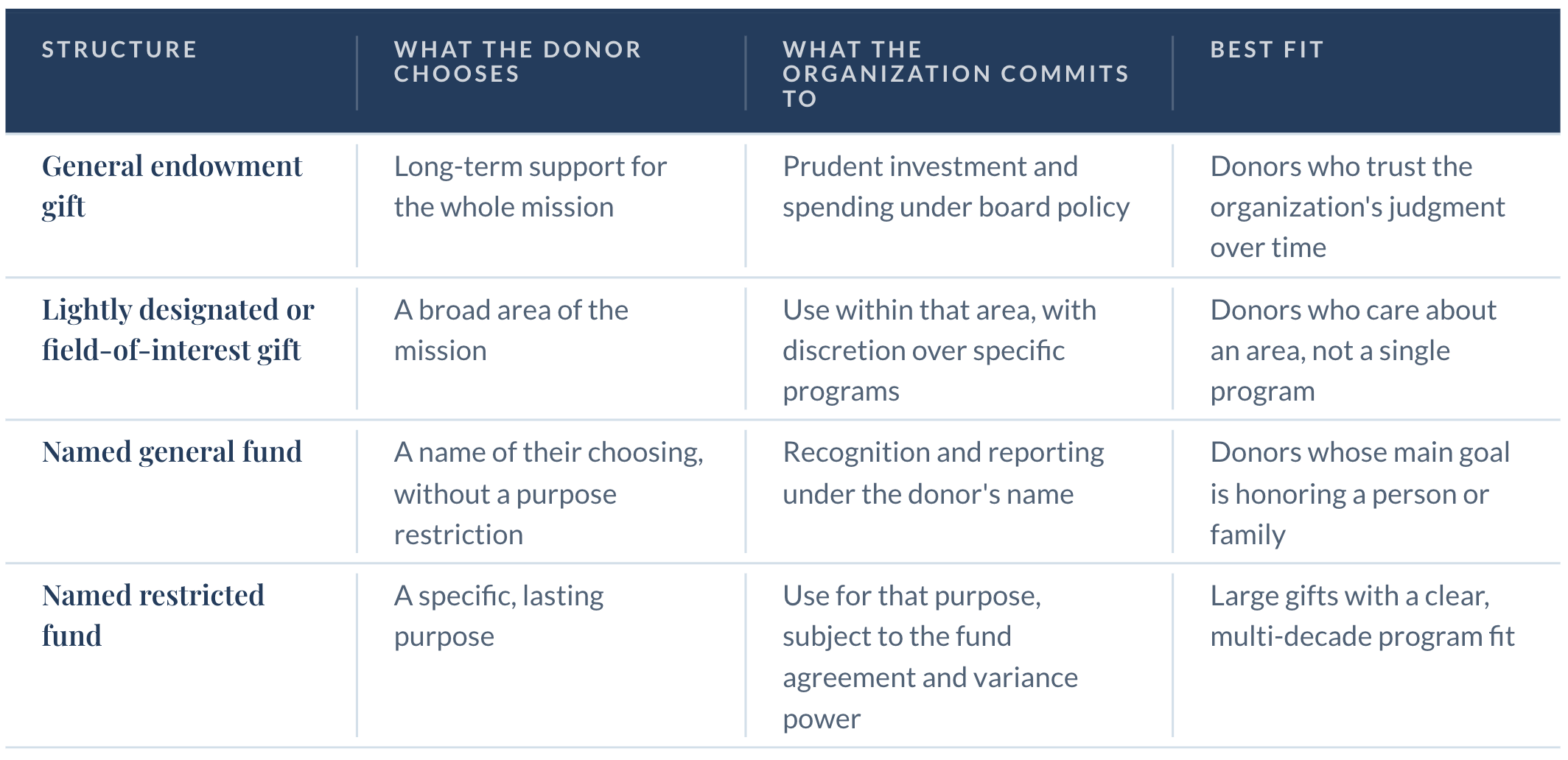
Raise flexibility and variance power early, before the donor's attorney or your own board asks about them. Raised early, they read as stewardship. Raised late, they can read as backpedaling.
"Some donors want their fund tied to one specific program. Others prefer a broader purpose so the fund can follow the work as it evolves. Both are wonderful gifts. Which feels closer to what you have in mind?"
The goal isn't to talk donors out of restricted gifts. It's to make sure every restriction is chosen on purpose and written to last. As covered in Part 2: Endowment Governance 101, restricted fund minimums and variance power language belong in your gift acceptance policy, so staff are explaining policy rather than negotiating fresh with each donor.
THE TAKEAWAY: Start with the general option, offer the middle ground next, and when a restriction is the right answer, write it to last.
Use the Restricted Fund Agreement Template on the following pages, and bring the checklist into the donor conversation itself.

Download our Guide to Structuring Endowment Gifts to learn how to evaluate donor restrictions, balance flexibility with donor intent, and make informed decisions that support your nonprofit’s long-term mission.



We'd like to learn more about your organization and understand your unique investment needs.
Or call: (608) 291-4646
Get notified of new guides and resources and receive monthly market commentaries.
Schedule a time to speak with a nonprofit investment advisor
Whatever your investment needs, our advisors are here to answer questions or explain your investment options in more detail.
(608) 291-4646 or hello@getecio.com
Select a meeting type:

15-Minute Question & Answer Session
Ask an advisor a question about your current or future investment program.


30-Minute Investment Overview
Learn how eCIO can help your nonprofit establish and enduring investment program.

60-Minute Consultation
Schedule a meeting with your investment committee.



Have a quick investment question?
Submit a question and a nonprofit advisor will respond promptly.