Discover free nonprofit investing resources, including policies, guides, and templates, to keep your investment or endowment program running strong.
Many nonprofits are rethinking how they manage investment assets. Learn what an Outsourced Chief Investment Officer (OCIO) is and how it differs from traditional investment consulting.
Whether it’s an endowment securing future programs or reserve funds providing a safety net for rainy days, a nonprofit’s financial assets carry a promise to the community it serves. Historically, boards and investment committees have often relied on investment consultants to help oversee these assets while retaining responsibility for investment decisions. As investment portfolios grow, nonprofit leaders often find themselves asking an important question:
Do we have the expertise, time, and resources to effectively manage our investments internally, and is that the best use of our board and staff's limited time?
For a growing number of nonprofits, the answer is leading them toward an Outsourced Chief Investment Officer, or OCIO.
An Outsourced Chief Investment Officer (OCIO) is a fiduciary investment partner that assumes responsibility for implementing and managing an organization's investment program within guidelines established by the Board and Investment Committee.
Think of an OCIO as an outsourced investment department.
Rather than relying solely on volunteer committee members or internal staff to oversee investment decisions, an organization partners with a professional investment team responsible for portfolio management, manager selection, risk oversight, reporting, and day-to-day implementation.
The Board and Investment Committee continue to establish investment objectives, spending needs, risk parameters, and governance policies. The OCIO manages the portfolio within those guidelines and provides ongoing reporting and accountability.
For decades, nonprofit organizations generally followed one of two approaches.
Some organizations managed investments internally, often relying on a staff member, board member, or volunteer with investment experience. While this approach can work, it creates challenges when investment expertise is concentrated in a single individual.
What happens when that person leaves the organization?
Others hired investment consultants. Beginning in the 1980s, the investment consultant model became the standard for foundations, endowments, and other institutional investors.
Consultants provided valuable expertise by conducting manager searches, recommending asset allocations, and helping committees oversee investment programs. However, consultants typically operate in a non-discretionary capacity. They provide recommendations, but the Board or Investment Committee retains responsibility for making and implementing investment decisions.
A simple way to think about the evolution is:
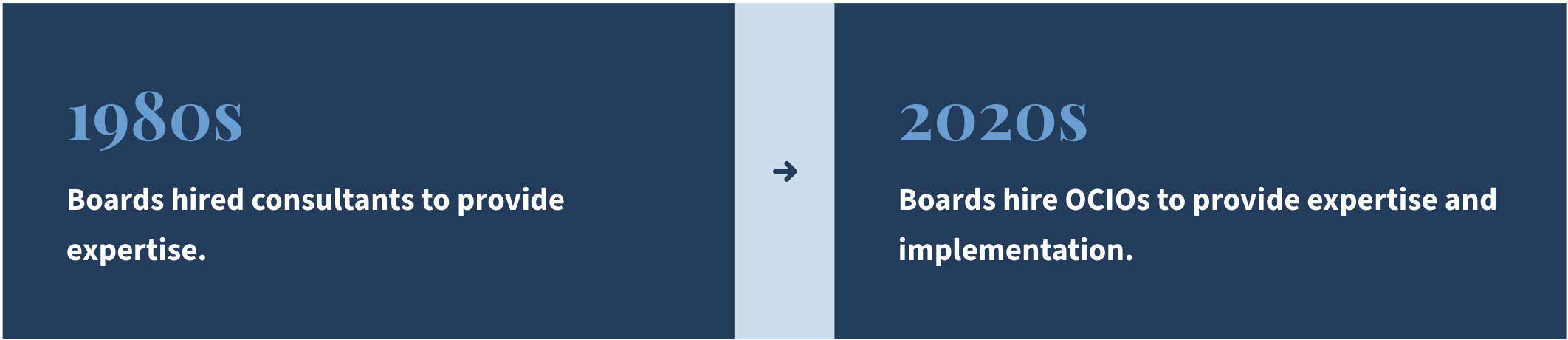
Twenty years ago, the OCIO model was primarily reserved for large endowments and foundations with institutional-scale portfolios.
Today, improvements in technology, portfolio construction, and service delivery have made professional OCIO services accessible to organizations of all sizes. At the same time, investment programs have become increasingly complex. Many nonprofits now face decisions involving global diversification, alternative investments, cash management strategies, spending policies, risk management, and heightened fiduciary expectations.
Rather than relying on internal resources, many organizations are choosing to outsource those responsibilities to a dedicated investment team.
As a result, small and mid-sized nonprofits have become some of the fastest-growing adopters of the OCIO model.
While every organization is different, several common themes emerge when nonprofits evaluate an OCIO relationship.
Most nonprofit boards consist of talented volunteers with diverse backgrounds. Few organizations have committee members who can dedicate significant time to monitoring markets, evaluating managers, reviewing performance, and implementing portfolio changes.
An OCIO provides access to a dedicated investment team without requiring the organization to hire internal staff.
Board members are responsible for overseeing investment assets, but many do not want to spend meeting time discussing fund replacements, rebalancing trades, or manager due diligence.
An OCIO allows committees to focus on governance, policy, and long-term objectives while delegating day-to-day investment management responsibilities.
Traditional consultant relationships often require recommendations to be reviewed and approved at the next committee meeting before action can be taken.
An OCIO can implement decisions within established guidelines, allowing portfolios to be managed more efficiently and consistently.
Beyond investment management, many OCIOs provide performance reporting, cash management guidance, policy support, audit assistance, and coordination with organizational leadership.
Most nonprofits do not have the scale or need for dedicated investment staff. An OCIO provides access to institutional-quality investment management, research, reporting, and oversight in a cost-effective structure that allows organizations to focus resources on advancing their mission.
The most important distinction is not who sets investment goals. The Board retains that responsibility in both models.
The difference lies in who is responsible for implementation.
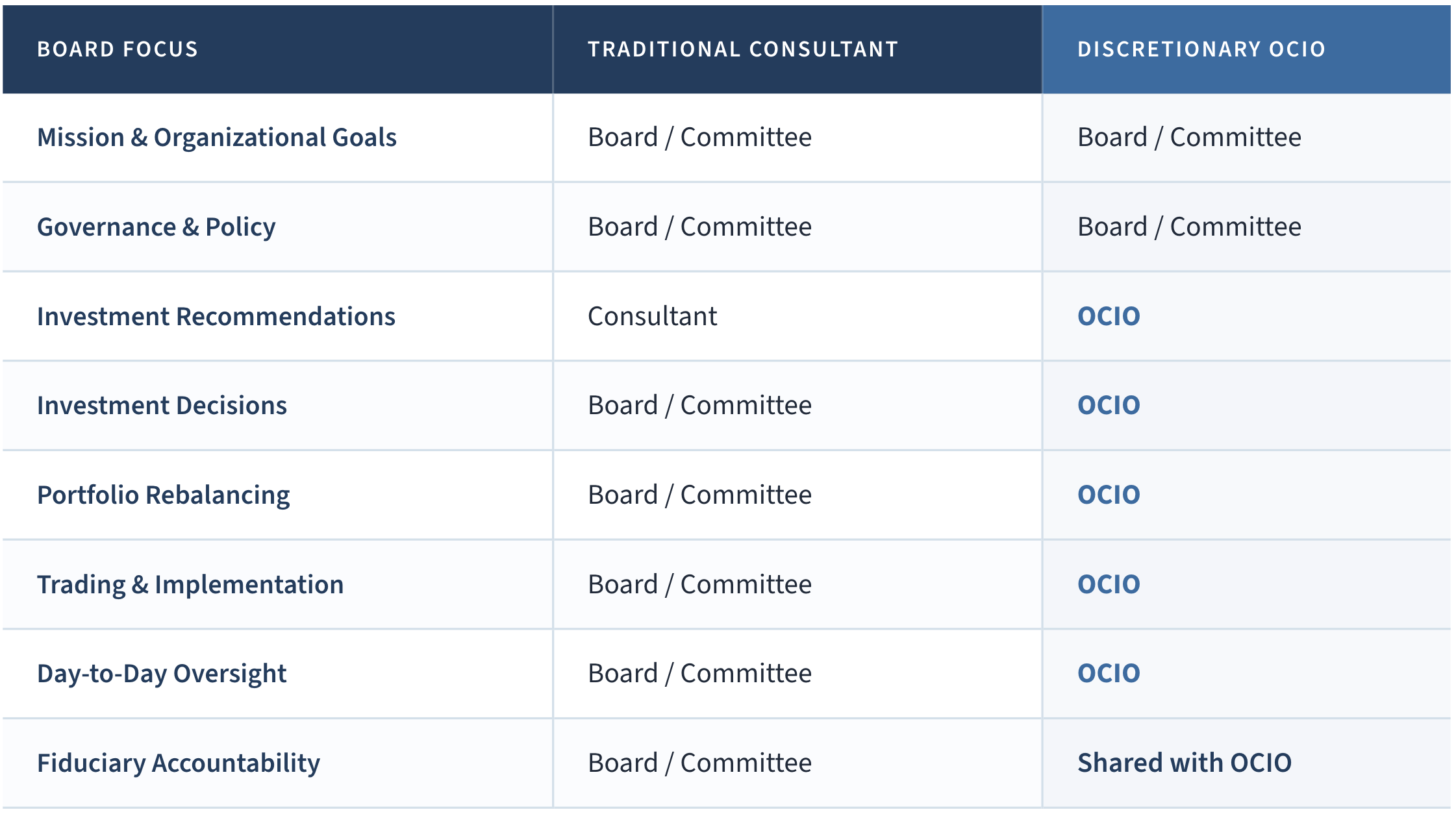
In a traditional consulting relationship, the Board governs and implements.
In an OCIO relationship, the Board governs while the OCIO implements.
The Board remains responsible for governance, oversight, and defining success. The OCIO assumes responsibility for managing the investment program within those established guidelines.
An OCIO relationship may be worth considering if your organization:
Ultimately, the question is not whether your organization can manage investments internally.
The better question may be:
For many nonprofits today, that question is leading them to explore the OCIO model.
1. What is an OCIO?
An Outsourced Chief Investment Officer (OCIO) is a fiduciary partner that manages and implements an organization’s investment program within board-approved guidelines.
2. How is an OCIO different from an investment consultant?
A consultant provides recommendations, but the board makes and implements decisions. An OCIO provides recommendations and has authority to execute investment decisions on the organization’s behalf.
3. How do I know if an OCIO is right for my organization?
An OCIO may be a good fit if your organization has investment assets, lacks consistent investment expertise, wants stronger fiduciary oversight, or would benefit from spending less time on investment administration and more time on mission-focused priorities.

Download the Nonprofit Portfolio Governance Audit Checklist to uncover hidden operational inefficiencies and vulnerabilities and see if your organization would benefit from an OCIO model.



We'd like to learn more about your organization and understand your unique investment needs.
Or call: (608) 291-4646
Get notified of new guides and resources and receive monthly market commentaries.
Schedule a time to speak with a nonprofit investment advisor
Whatever your investment needs, our advisors are here to answer questions or explain your investment options in more detail.
(608) 291-4646 or hello@getecio.com
Select a meeting type:

15-Minute Question & Answer Session
Ask an advisor a question about your current or future investment program.


30-Minute Investment Overview
Learn how eCIO can help your nonprofit establish and enduring investment program.

60-Minute Consultation
Schedule a meeting with your investment committee.



Have a quick investment question?
Submit a question and a nonprofit advisor will respond promptly.